Influencer Product Seeding: Generate Authentic Interest
Influencer product seeding in 2026: gift free product to the right creators for authentic, organic content. Well-run programs return 3–8x ROI — here's how to run one.
Influencer product seeding — sending free product to relevant creators with no obligation to post — has quietly become one of the highest-ROI plays in the influencer playbook. Well-run seeding programs now return 3–8x ROI, and in 2025 seeding made up 31% of all campaigns on Aspire, up from 20% a year earlier. This guide explains what product seeding is, when it works, and how to design a campaign that turns gifted product into authentic, organic buzz.
What is influencer product seeding?
Influencer product seeding or product gifting indicates sending products to relevant influencers to generate content around the product and start long-lasting relationships with the influencers. It aims at organically creating interest from the influencer in your product. In opposition to paid content, where the creators are obligated to generate content, there is no guarantee of return with influencer product seeding.
Why influencer product seeding?
If there is no return guarantee, why would anyone start an influencer product seeding campaign? Because the content generated by an influencer product seeding campaign will be genuine and authentic. Unlike a scripted campaign, influencer product seeding allows content creators to express their honest opinions. Honesty is one of the most appreciated characteristics of influencers, and using a marketing strategy that can build upon it will be a winning choice.
That authenticity is exactly why the numbers favour seeding. According to Aspire’s 2026 data, 69% of marketers say influencer-generated content outperforms brand-directed content, and 77% now repurpose creator content directly inside their paid social campaigns. GRIN reports that a creator post costing roughly $40 in product can become a paid ad that outperforms a $5,000 agency-produced asset — which is how seeding compounds far beyond the organic post itself.
What are the benefits of influencer product seeding?
It provides a low-cost way to establish relationships with influencers who really like your product while improving the social proof around your product.
Influencer product seeding benefits your marketing plans and the audience’s perception of your brand. Nailing a campaign can be a total game changer for your reach and image. Here are the core benefits, especially as they relate to influencer marketing:
Low cost per creator $30–$80
Gifting a micro-creator (10K–50K followers) costs roughly $30–$80 in product, letting you reach a large pool of influencers at a fraction of a paid campaign’s budget.
Filters for genuine fit No obligation
Nobody is contractually required to post. The creators who do are the ones who truly connect with your product — weeding out anyone who’d only show up for the money.
Relationships at scale 20–100/mo
Brands gift to 20–100 creators a month, portraying the brand as generous and confident while building a roster of warm partners for future paid work.
Organic reviews & social proof 92% trust peers
Seeded content creates a track record of honest reviews. With 92% of consumers trusting peer recommendations over brand messaging, that social proof compounds reach.
When does influencer product seeding work best?
Influencer product seeding can work towards influencers of any size and for any product. But is best suited for small creators and for products that are particularly visual.
Small creators
Nano-influencers and micro-influencers will be more responsive to influencer product seeding campaigns, especially if your brand is not a large and prominent name. Large creators may also like your product but are unlikely to create unpaid content for your brand. This is not necessarily a downside since micro-influencers are some of the best-performing when it comes to influencer marketing.
Visually striking products
The product you will seed will benefit from being visually appealing and prone to be turned into content. Fancy packaging, bright colors, or unexpected features will be easily turned into content. Conversely, a software subscription may be harder to present well (but your software may be doing something astonishing, so never say never).
How to design an influencer product seeding campaign
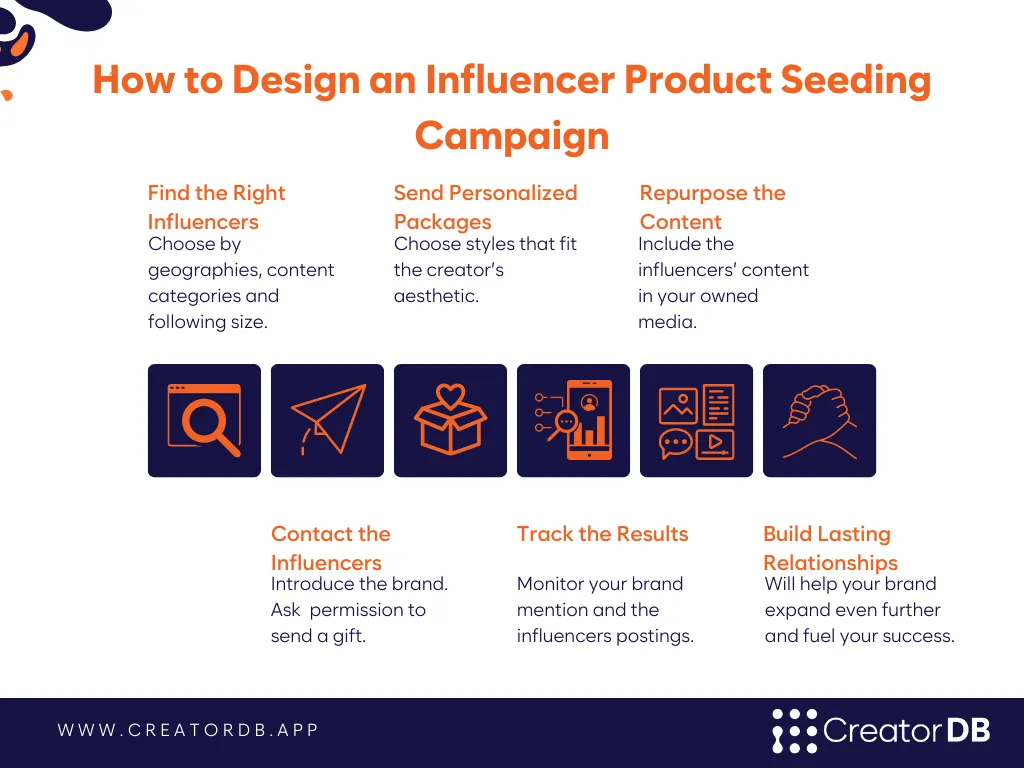
To create a successful influencer product seeding campaign you want to find relevant influencers, reach out to them, and send your product to the one interested, track the results and repurpose the eventual content the influencers make.
Now that you know what an influencer product seeding campaign is and when it is best to use, let’s think about translating everything into practice. In this section, you will learn all the steps to consider when designing your campaign.
Find influencers in line with your product
With millions of influencers spread worldwide, no one can contact each of them. That’s why you must individuate the ones that will help achieve your campaign goals. You can do this by establishing which geographies you are interested in, what content categories the influencers should be posting about, and their follower size, then using an influencer discover software, like CreatorDB, to individuate them and obtain their contact information quickly. Alternatively, you can manually search for them on social media using hashtags.
But content categories and the following size are not all. You should also consider whether their style and values align with your brand and how they place themselves towards sponsors and promoting products.
Use CreatorDB’s free tools to surface micro- and nano-creators by niche, platform and engagement — then grab their contact details before you ship product.
Open the free Influencer Search Tool → Find an influencer by email →Reach out to the influencers to understand if they are interested
Before sending out packages, contact the influencer and introduce your brand to them. Let them know you want to send them a present, and if they are okay with it. This first contact with the creators will help your brand look professional and respectful, helping establish a solid foundation for a mutually beneficial, long-lasting relationship.
Send personalized packages
Everyone likes to feel special, and influencers are no different. If you want to increase your chances of generating content around your product, you should put in the work to tailor each gift to the creator who will receive it. You can create personalized cards and choose colors and styles that fit the creator’s aesthetic, plus add your touch to make it feel coming from someone who truly cares about them. While mass sending the same package over and over can seem tempting from a convenience standpoint, it will always have a different impact and effect than a carefully prepared gift.
Track the results
As for each of your marketing campaigns, you should collect data about your performances and have benchmarks for the results. But in the case of influencer product seeding campaigns, this can be tricky since you will need not know where the content will be published and in which form. A common way to address this problem is by keeping track of the influencers you contacted on various social media platforms and monitoring your brand mention across the board. While not knowing where the buzz will come from can be unnerving for some, it can also be the chase for you to discover your brand potential on platforms you had not considered before.
Repurpose the content
Once you start seeing content about your product emerging is time to make it work for you: it can be incorporated into your social media to support exposure and reach or in your website to increase social proof. There are many ways that you can decide to include the influencers’ content in your owned media; how to go at it is up to you.
Build lasting relationships
Now that you have established a first connection with content creators genuinely interested in your product, it is time to nurture it. Use these first connections to launch long-term relationships that will help your brand expand even further and fuel your success. One way would be to turn these content creators into brand ambassadors. Otherwise, consider creating special promotions for them and their followers.
Product seeding best practices
By now, you should be very clear about how influencer product seeding works and how to get great results. But let me give you a final piece of advice to cement your success. These are some best practices for obtaining a smooth experience from your campaign and getting the best results possible.
Don’t push for content
It may sound obvious to some, but it is essential to remember it. Even if you send these influencers your product, they do not owe you anything. It was a gift, after all. Be happy with the content you will receive, and you will, but don’t dwell too much on the one that doesn’t show up. It is useless to contact the one who didn’t create any content and try to get some out of them, and it would just make your brand look petty.
Seek feedback
Use this influencer product seeding as a chance to test your product. Look at all the comments the influencers gave, and when they are negative, think about how you can improve upon them. If you find solutions or improvements to the criticism and flaws of your product, consider sending a new and improved product to the influencers to have a new review done, highlighting how you took their critics at heart and used them to improve.
Engage with the influencer’s content
Increase your brand visibility by interacting with the creators talking about you. Keep it friendly and joyful even if there are some negative comments. You want to use this occasion to introduce your brand to their followers and gain their trust and respect.
Work with CreatorDB
Put this into
practice.
Talk to our Asia agency team about applying these ideas to a real creator campaign — or open the CreatorDB app and start building your shortlist now.
Frequently Asked Questions.
What is influencer product seeding and how does it differ from paid sponsorships?
Product seeding sends your product to relevant creators with no obligation to post content, whereas paid sponsorships guarantee coverage in exchange for a fee. Seeding generates authentic content because creators only post if they genuinely like the product — there's no script or contract. This authenticity resonates stronger with audiences than sponsored content, since creators express honest opinions rather than contractual messaging.
Does product seeding actually deliver ROI in 2026?
Yes. Well-run product seeding programs typically return 3–8x ROI (GRIN, 2026), and seeding made up 31% of all campaigns on Aspire in 2025, up from 20% the year before. It costs far less than paid work — roughly $30–$80 in product to gift a micro-creator — yet 69% of marketers say creator-made content outperforms brand-directed content, and 77% now repurpose that content inside paid social ads where it compounds far beyond the original organic post.
What types of products and creators work best for seeding campaigns?
Nano- and micro-influencers respond most actively to seeding, especially when your brand lacks broad recognition. Large creators rarely produce unpaid content. Products with strong visual appeal — distinctive packaging, bright colors, unique design — perform best because they're easily photographable and shareable. Software subscriptions and less visual products face higher barriers to content generation.
What are the main benefits of running an influencer product seeding campaign?
Seeding reaches many creators at lower cost than paid campaigns — brands commonly gift 20 to 100 creators a month — identifies genuinely interested partners, and builds relationships at scale. It generates organic reviews and social proof, which matters because 92% of consumers trust peer recommendations over brand messaging. Well-run programs see 20–40% post rates, and the strategy works especially well for discovering micro-influencers whose audiences align with your target market, making them valuable for future paid partnerships.
How do you execute an influencer product seeding campaign from start to finish?
Identify relevant creators across your target audience and verticals, then reach out with a personalized pitch explaining why you chose them. Send products to interested creators, track who receives and engages with items, and monitor emerging content across their channels. Repurpose any organic posts they create as social proof, and use insights from responsive creators to prioritize future paid partnerships.